Welcome!
Maize is a major crop in the U.S. and a classical genetic system, particularly well suited for cytogenetics. Its genome is divided among 10 chromosomes, and gene locations can be charted in one of three fundamentally different ways-analysis of trait linkage for a genetic map, DNA sequence determination for a physical map, and microscopic visualization for a cytogenetic map. Integration of the three map types in fruit flies and humans has proven to accelerate genetic research. The production of a similar trio of integrated maps for maize would advance understanding of the genetic material of one of the world's most important cereal crops.
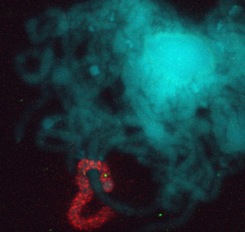
This project takes advantage of recent advances in cytogenetics and new plant genomic resources from other NSF Plant Genome Research Program projects. The goal is to produce a cytogenetic map of the entire maize genome. The rapid and cost-efficient method this project will employ is to use segments of sorghum DNA (maize-marker-selected sorghum BAC clones) as probes to stain the corresponding regions on maize chromosomes by fluorescence in situ hybridization (FISH). The results will be integrated with other genome maps and released immediately into GenBank and MaizeGDB for public access. The project will advance downstream research by aiding in physical map assembly, establishing new reagents for chromosome research, and providing insights into the evolution of maize and related grasses.
The deliverables for this project will be the development of FISH mapping tools and the placement of hundreds of genetic marker loci on the cytogenetic map of the maize genome.
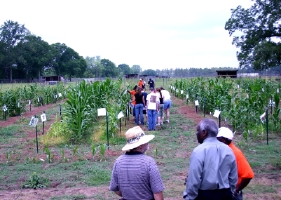
A local outreach project, the Maize 10 Maze project, used the new cytogenetic map to guide the production of a field replicate of the maize genome in which individual rows represent single chromosomes. This self-guided public tour of the maize genome will raise public awareness of how plant genome research can benefit society, relating genome research to issues of public interest such as food production, plant biology, renewable energy, and genetic diversity.
Publications
Preceding and Related Publications
Koumbaris GL and Bass HW.
(2003)
"A new single-locus cytogenetic mapping system for maize (Zea mays L.):
overcoming FISH detection limits with marker-selected sorghum (S. propinquum L.) BACs clones." The Plant Journal 35:647-659.
Anderson LK, Salameh N, Bass HW, Harper LC, Cande WZ, Weber G, and Stack SM.
(2004)
"Integrating Genetic Linkage Maps with Pachytene Chromosome Structure in Maize."Genetics 166:1923-1933.
Selected Publications from This Project (full listing on Findings page)
Lawrence CJ, Seigfried TE, Bass HW, and Anderson LK. (2006)
"Predicting Chromosomal Locations of Genetically Mapped Loci in Maize Using the Morgan2McClintock Translator." Genetics 172:2007-2009.
Amarillo FE and Bass HW. (2007) "A Transgenomic Cytogenetic Sorghum (Sorghum propinquum) BAC FISH Map of Maize (Zea mays L.) Pachytene Chromosome 9, Evidence for Regions of Genome Hyperexpansion." Genetics 177:1509-1526.
Okagaki RJ; Jacobs MS; Stec AO; et al. (2008)
"Maize Centromere Mapping: A Comparison of Physical and Genetic Strategies."
Journal of Heredity 99:85-93.
Figueroa DM and Bass HW. (2010) "A Historic and Modern Perspective on Plant Cytogenetics."
Briefings in Functional Genomics and Proteomics 9(2):95-102.
[ PubMed 20110271 |
doi:10.1093/bfgp/elp058 | PDF ]
Local News and Events
- Fall 2003, project announcement from FSU Headlines
Radio: RealAudio
- Summer 2004, Mutants of Maize Field Day, 21 June 2004, Mission Road Field; FSU
A prelude to the Maize-10-Maze project.
Event pictures by Karen Graffius
TV: WTCV Channel 6, Feature at Five MOV clip
- Summer 2006 Mutants of Maize Field Day, 23 June 2006, FAMU Research Farm, Quincy, FL
- Summer 2007 Mutants of Maize Field Day, 20 June 2007, FAMU Research Farm, Quincy, FL
|