 |
1997. Phylogenetic analysis of phenotypic covariance structure. II. Reconstructing matrix evolution. Steppan, S.J. Evolution. 51(2):587-594. |
|
1997. Phylogenetic analysis of phenotypic covariance structure. II. Reconstructing matrix evolution. Steppan, S.J. Evolution. 51(2):587-594. |
A modified minimum evolution approach is used to estimate covariance matrices for hypothetical ancestors. Branch lengths are calculated as the mean disparity in corresponding ancestor-descendent covariances. Branches are longest leading to terminal populations and subspecies, while interspecific branches are relatively short, indicating a general conservation of covariance structure among species despite a high degree of intraspecific variability. Absolute deviations in covariance structure are not correlated with phenotypic divergence. Interpreted in light of other studies, the analyses suggest that deviations in covariance structure are most strongly associated with the formation of diagnosably distinct taxa and stochastic sampling of genotypes at the population level. There is no evidence for restructuring of phenotypic covariance structure in association with reproductive isolation. The results suggest that phenotypic covariances are dynamic over short time scales and do not support attempts to extrapolate genetic covariance structure to explain or predict macroevolutionary change.
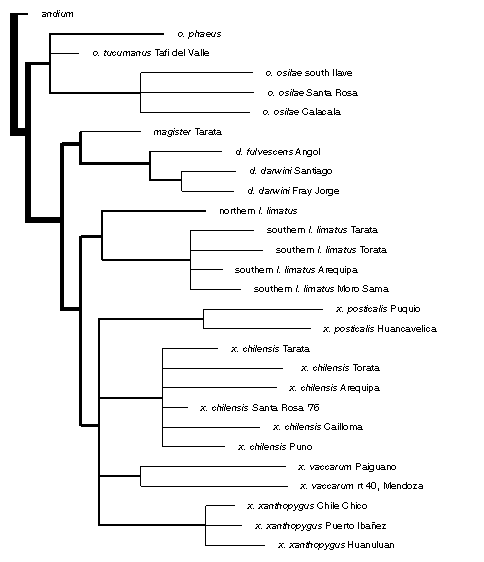
Fig. 1. Phylogram for analyzed species of Phyllotis with estimated branch lengths scaled by the matrix disparity between ancestor-descendent pairs. Branch thickness indicates the phylogenetic level of the branch: the thinnest branches lead to the local populations.
| Phylogenetic level | n | Matrix disparity, mean | Euclidean distance, mean |
| population | 24 | 1.14 | 0.92 |
| subspecies | 10 | 1.12 | 1.06 |
| species | 5 | 0.48 | 1.23 |
| species-group | 2 | 0.25 | 0.82 |
| 2nd species-group | 1 | 0.49 | 1.33 |
| Branch type | |||
| intraspecific | 34 | 1.14 | 0.97 |
| interspecific | 8 | 0.43 | 1.14 |