evolution in a community context
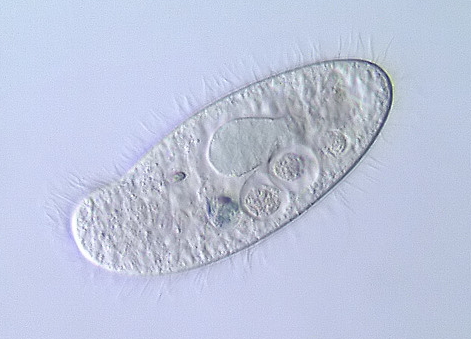 The Miller Lab, along with the lab of Olivia
Mason (EOAS, FSU), are using the natural, small, microbial
ecosystem found in the water-filled leaves of pitcher plant to
test predictions about how niches will change as species evolve.
We are asking if species evolve differently in communities
of increasing complexity using selection experiments on protozoa
in Sarracenia purpurea leaves. The theory of niche partitioning,
which is thought to lead to coexistence, will be supported if species
co-evolve to have reduced competitive interactions, while
niche convergence would be supported if increased competitive
interactions evolve in multispecies systems. We
are also using next-generation DNA sequencing to
quantify the bacterial communities use by each protozoa species,
in order to also ask if resource niches evolve.
The Miller Lab, along with the lab of Olivia
Mason (EOAS, FSU), are using the natural, small, microbial
ecosystem found in the water-filled leaves of pitcher plant to
test predictions about how niches will change as species evolve.
We are asking if species evolve differently in communities
of increasing complexity using selection experiments on protozoa
in Sarracenia purpurea leaves. The theory of niche partitioning,
which is thought to lead to coexistence, will be supported if species
co-evolve to have reduced competitive interactions, while
niche convergence would be supported if increased competitive
interactions evolve in multispecies systems. We
are also using next-generation DNA sequencing to
quantify the bacterial communities use by each protozoa species,
in order to also ask if resource niches evolve.
vegetation dynamics in coastal dunes
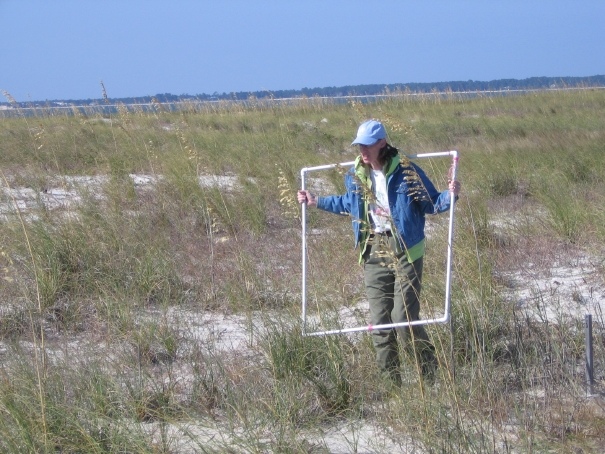 We
are interested in both the short- and long-term patterns of
vegetation on barrier islands in the Northern Gulf of Mexico.
Barrier islands occur along many coastlines worldwide in areas
prone to high disturbance from storms. Understanding coastal
dunes is very important for the ecology, conservation, and economy
of coasts worldwide and they have been the subject of many classic
studies in ecology, going back to Cowles and Warming in the late
1800's..
We
are interested in both the short- and long-term patterns of
vegetation on barrier islands in the Northern Gulf of Mexico.
Barrier islands occur along many coastlines worldwide in areas
prone to high disturbance from storms. Understanding coastal
dunes is very important for the ecology, conservation, and economy
of coasts worldwide and they have been the subject of many classic
studies in ecology, going back to Cowles and Warming in the late
1800's..
The original project began on St. George Island in 1999, when we established 6 large sampling grids across foredune, interdune, and backdune areas at the eastern tip of the island. These plots have since been censused annually and were expanded to 9 plots in 2010. In 2010 we also began similar annual sampling on Crooked Island near Panama City and Santa Rosa Island near Pensacola. These sites have been used to explore community patterns in the Northern Gulf of Mexico, as well as to understand the effects of weather events on vegetation and to inform conservation and management.
Ecology of sarracenia purpurea inquilines
 The
Miller Lab has been studying the microcosms inside the
water-filled leaves of the pitcher plant, Sarracenia purpurea,
since 1995. These small ecosystems are ideal for experimental
community ecology. We have since investigated spatial patterns in
communities (Harvey and Miller 1996), consumer vs. resource
control (the work of Jamie
Kneitel, including Kneitel and Miller 2002), metecommunity
dynamics (Kneitel and Miller 2004), ecosystem dynamics (Mouquet et
al. 2008), and, more recently, selection and evolution in protozoa
(led by Casey terHorst;
terHorst 2010, Miller et al. 2014). We have continued to
collaborate with wonderful colleagues on this work, especially Sarah
Grey, Aaron Ellison, Nick Gotelli, Dominique Gravel, Bill
Bradshaw, and Christine Holzapfel.
The
Miller Lab has been studying the microcosms inside the
water-filled leaves of the pitcher plant, Sarracenia purpurea,
since 1995. These small ecosystems are ideal for experimental
community ecology. We have since investigated spatial patterns in
communities (Harvey and Miller 1996), consumer vs. resource
control (the work of Jamie
Kneitel, including Kneitel and Miller 2002), metecommunity
dynamics (Kneitel and Miller 2004), ecosystem dynamics (Mouquet et
al. 2008), and, more recently, selection and evolution in protozoa
(led by Casey terHorst;
terHorst 2010, Miller et al. 2014). We have continued to
collaborate with wonderful colleagues on this work, especially Sarah
Grey, Aaron Ellison, Nick Gotelli, Dominique Gravel, Bill
Bradshaw, and Christine Holzapfel.